Showing posts with label Peace sign. Show all posts

Sunday, March 23, 2014

Pacifism

File:Peace sign.svg

Pacifism is opposition to war and violence. The word pacifism was coined by the French peace campaigner Émile Arnaud (1864–1921) and adopted by other peace activists at the tenth Universal Peace Congress in Glasgow in 1901. A related term is ahimsa (to do no harm), which is a core philosophy in Buddhism, Jainism, and Hinduism. While modern connotations are recent, having been explicated since the 19th century, ancient references abound.

In Western religion, Jesus Christ's injunction to "love thy neighbour" and asking for forgiveness for his crucifiers "for they know not what they do" have been interpreted as calling for pacifism. In modern times, interest was revived by Leo Tolstoy in his late works, particularly in "The Kingdom of God Is Within You." Mohandas Gandhi (1869–1948) propounded the practice of steadfast nonviolent opposition which he called "satyagraha", instrumental in its role in the Indian Independence Movement. Its effectiveness served as inspiration to Martin Luther King Jr., James Lawson, James Bevel,[3] and many others in the 1950s and 1960s American Civil Rights Movement. Pacifism was widely associated with the much publicized image of Tiananmen Square Protests of 1989 with the "Tank Man", where one protester stood in nonviolent opposition to a column of tanks.

Definition

Pacifism covers a spectrum of views, including the belief that international disputes can and should be peacefully resolved, calls for the abolition of the institutions of the military and war, opposition to any organization of society through governmental force, rejection of the use of physical violence to obtain political, economic or social goals, the obliteration of force except in cases where it is absolutely necessary to advance the cause of peace, and opposition to violence under any circumstance, even defence of self and others. Historians of pacifism Peter Brock and Thomas Paul Socknat define pacifism "in the sense generally accepted in English-speaking areas" as "an unconditional rejection of all forms of warfare". Philosopher Jenny Teichman defines the main form of pacifism as "anti-warism", the rejection of all forms of warfare. Teichman's beliefs have been summarized by Brian Orend as "...A pacifist rejects war and believes there are no moral grounds which can justify resorting to war. War, for the pacifist, is always wrong." In a sense the philosophy is based on the idea that the ends do not justify the means.

Tuesday, March 4, 2014

Peace symbols - The broken rifle

File:Broken rifle.svg

The broken rifle symbol is used by War Resisters' International (WRI) and its affiliates but predates the foundation of WRI in 1921. The first known example of the symbol is in the masthead of the January 1909 issue of De Wapens Neder (Down With Weapons), the monthly paper of the International Antimilitarist Union in the Netherlands. In 1915 it appeared on the cover of a pamphlet, Under det brukne Gevær (Under the Broken Rifle), published by the Norwegian Social Democratic Youth Association. The (German) League for War Victims, founded in 1917, used the broken rifle on a 1919 banner.

In 1921, Belgian workers marching through La Louvrière on 16 October 1921, carried flags showing a soldier breaking his rifle. Ernst Friedrich, a German who had refused military service, founded the Anti-Kriegs Museum in Berlin, which featured a bas-relief broken rifle over the door. The Museum distributed broken-rifle badges, girls' and women's brooches, boys' belt buckles, and men's tie pins.

Tuesday, February 18, 2014

The peace sign


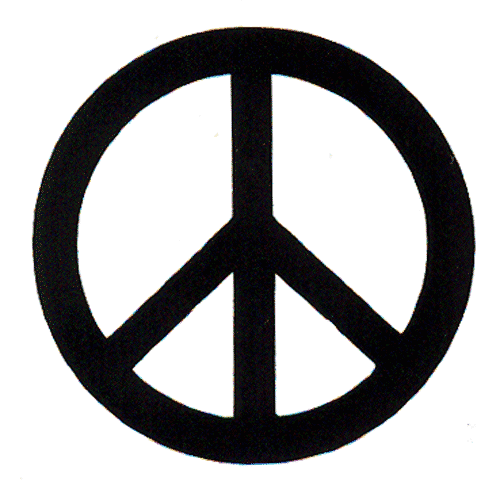
The internationally recognized symbol for peace (U+262E ☮ peace symbol in Unicode) was originally designed in 1958 for the British nuclear disarmament movement by Gerald Holtom. Holtom, an artist and designer, made it for a march from Trafalgar Square, London to the Atomic Weapons Research Establishment at Aldermaston in England, organised by the Direct Action Committee to take place in April and supported by the Campaign for Nuclear Disarmament (CND). Holtom's design was adapted by Eric Austen (1922–1999) to ceramic lapel badges. The original design is in the Peace Museum in Bradford, England.
The symbol is a combination of the semaphore signals for the letters "N" and "D," standing for "nuclear disarmament". In semaphore the letter "N" is formed by a person holding two flags in an inverted "V," and the letter "D" is formed by holding one flag pointed straight up and the other pointed straight down. Superimposing these two signs forms the shape of the centre of the peace symbol. Holtom later wrote to Hugh Brock, editor of Peace News, explaining the genesis of his idea:
"I was in despair. Deep despair. I drew myself: the representative of an individual in despair, with hands palm outstretched outwards and downwards in the manner of Goya's peasant before the firing squad. I formalised the drawing into a line and put a circle round it."
Ken Kolsbun, a correspondent of Holtom's, says that the designer came to regret the symbolism of despair, as he felt that peace was something to be celebrated and wanted the symbol to be inverted. Eric Austen is said to have "discovered that the 'gesture of despair' motif had long been associated with 'the death of man', and the circle with 'the unborn child',". Some time later, Peggy Duff, general secretary of CND between 1958 and 1967, repeated this interpretation in an interview with a US newspaper, saying that the inside of the symbol was a "runic symbol for death of man" and the circle the "symbol for the unborn child".


The symbol became the badge of CND and wearing it became a sign of support for the campaign urging British unilateral nuclear disarmament. An account of CND's early history described the image as "a visual adhesive to bind the [Aldermaston] March and later the whole Campaign together ... probably the most powerful, memorable and adaptable image ever designed for a secular cause."

Not patented or restricted, the symbol spread beyond CND and was adopted by the wider disarmament and anti-war movements. It became widely known in the United States in 1958 when Albert Bigelow, a pacifist protester, sailed a small boat fitted with the CND banner into the vicinity of a nuclear test. Buttons with the symbol were imported into the United States in 1960 by Philip Altbach, a freshman at the University of Chicago. Altbach had traveled to England to meet with British peace groups as a delegate from the Student Peace Union (SPU) and, on his return, he persuaded the SPU to adopt the symbol. Between 1960 and 1964, they sold thousands of the buttons on college campuses. By the end of the decade, the symbol had been adopted as a generic peace sign, crossing national and cultural boundaries in Europe and other regions.

In 1970, two US private companies tried to register the peace symbol as a trade mark: the Intercontinental Shoe Corporation of New York and Luv, Inc. of Miami. Commissioner of Patents William E. Schuyler Jr, said that the symbol "could not properly function as a trade mark subject to registration by the Patent Office".
Ken Kolsbun in his history of the peace symbol wrote that, "In an attempt to discredit the burgeoning anti-war movement, the John Birch Society published an attack on the peace symbol in its June 1970 issue of American Opinion", calling the symbol "a manifestation of a witch's foot or crow's foot", supposedly icons of the devil in the Middle Ages. A national Republican newsletter was reported to have "noted an ominous similarity to a symbol used by the Nazis in World War II".